Average Reviews:

(More customer reviews)Are you looking to buy
Quacks and Crusaders: The Fabulous Careers of John Brinkley, Norman Baker, and Harry Hoxsey? Here is the right place to find the great deals. we can offer
discounts of up to 90% on
Quacks and Crusaders: The Fabulous Careers of John Brinkley, Norman Baker, and Harry Hoxsey. Check out the link below:
>> Click Here to See Compare Prices and Get the Best Offers
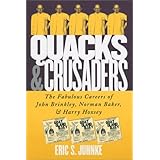
Quacks and Crusaders: The Fabulous Careers of John Brinkley, Norman Baker, and Harry Hoxsey ReviewWe have had a boom in interest in "alternative health care" recently, but that interest has been with us ever since there has been a medical establishment to which there could be "alternatives." In the American Midwest in the 1930s three alternative healers began a rise to financial, social, and political power. _Quacks & Crusaders: The Fabulous Careers of John Brinkley, Norman Baker, and Harry Hoxsey_ (University Press of Kansas) by Eric S. Juhnke documents the rise and fall of all three medical conmen, and gives a lesson in the dangers of credulousness.
John Brinkley was a licensed doctor, having graduated from a diploma mill. He latched on to the "gland transplant" experiments done on animals, and believed that transplanting animal glands into humans was a key for rejuvenation. "A man is as old as his glands, and his glands are as old as his sex glands," he proclaimed. Male goats were the randiest animals, so they were the tissue donors, but they turned out to be just the thing to boost female fertility and development of the bust, too. He compared himself to Jesus, gave sermons, and demonized the American Medical Association. Norman Baker specialized in cancer cures. He worked as a machinist and in vaudeville before settling down in Muscatine, Iowa. He persuaded city officials to let him start a radio station that would present honest-to-goodness down home programs as opposed to the high-brow fare coming from the cities. Baker called Morris Fishbein, the head of the AMA, the "Jewish dominator of the medical trust of America," and insisted that his clinic was a bastion for personal freedom and against the evils of urban industrialism. Harry Hoxsey proved to have the most staying power. He specialized in herbal cancer cures as well. Not a physician, he was able to enroll renegade physicians into his service, and he was bankrolled by an evangelist minister. In Dallas, he enjoyed poker, nightclubs, and womanizing, and his diatribes against interference by the AMA and the government won him friends from the political right wing.
Juhnke's tales of these colorful characters are great fun to read, even though the rascals bilked many of their patients of money and sometimes their lives. The eventual success of the AMA against them is not a pure victory; the shortcomings of the AMA at the time are examined here, too. Few people remember these quacks now. The towns that boosted them because they brought in business now view them as an embarrassing part of their histories. It is important that Juhnke has brought them again to our attention. We may no longer have such manifestations as goat gland transplants, but anyone who watches television knows that herbal cures, homeopathy, and healing magnets are still taking money from the gullible. There is still a large group of potential patients who view organized medicine (and governmental regulation of medical treatment) as some sort of conspiracy, and of course there are plenty of faith healers who are glad to have their flocks doubting the efficacy of regular medical treatment. People are finding it harder to pay for physicians, and drug costs are up. Brinkley, Baker, and Hoxsey may have eventually lost their power and their millions, but Juhnke's useful study reminds us that there are always healers ready to take their place.
Quacks and Crusaders: The Fabulous Careers of John Brinkley, Norman Baker, and Harry Hoxsey OverviewOne promoted goat gland transplants as a remedy for lost virility or infertility. Another blamed aluminum cooking utensils for causing cancer. The third was targeted by the Food and Drug Administration as "public enemy number one" for his worthless cures.John Brinkley, Norman Baker, and Harry Hoxsey were the ultimate snake oil salesmen of the twentieth century. With backgrounds in lowbrow performance—-carnivals, vaudeville, night clubs—-each of these charismatic con men used the emerging power of radio to hawk alternative cures in the Midwest beginning in the roaring twenties, through the Depression era, and into the 1950s. All scorned the medical establishment for avarice while amassing considerable fortunes of their own; and although the American Medical Association castigated them for preying on the ignorant, this book shows that the case against them wasn't all that simple.Quacks and Crusaders is an entertaining and revealing look at the connections between fraudulent medicine and populist rhetoric in middle America. Eric Juhnke examines the careers of these three personalities to paint a vision of medicine that championed average Americans, denounced elitism, and affirmed rustic values. All appealed to the common man, winning audiences and patrons in rural America by casting their pitches in everyday language, and their messages proved more potent than their medicines in treating the fears, insecurities, and failing health of their numerous supporters.Juhnke first examines the career of each man, revealing their flair as businessmen and propagandists-—with such success that Brinkley and Baker ran for governor of their states and Hoxsey had thousands of supporters protest his "persecution" by the FDA. Juhnke then investigates the identity, motives, and willingness to believe of their many patients and followers. He shows how all three men used populist rhetoric-—evangelical, anti-Communist, anti-intellectual—-to attract their clients, and then how their particular brand of populism sometimes mutated to anti-Semitism and other sentiments of the radical right.By treating the incurable, Brinkley, Baker, and Hoxsey took on the mantles of common folk crusaders. Brinkley was idolized for his goat gland cures until his death, and Hoxsey's former head nurse continued his work from Tijuana until her death in 1999. In considering who visits quacks and why, Juhnke has shed new light not only on the ongoing battle between alternative and organized medicine, but also on the persistence of quackery-—and gullibility—-in American culture.
Want to learn more information about
Quacks and Crusaders: The Fabulous Careers of John Brinkley, Norman Baker, and Harry Hoxsey?
>> Click Here to See All Customer Reviews & Ratings Now